
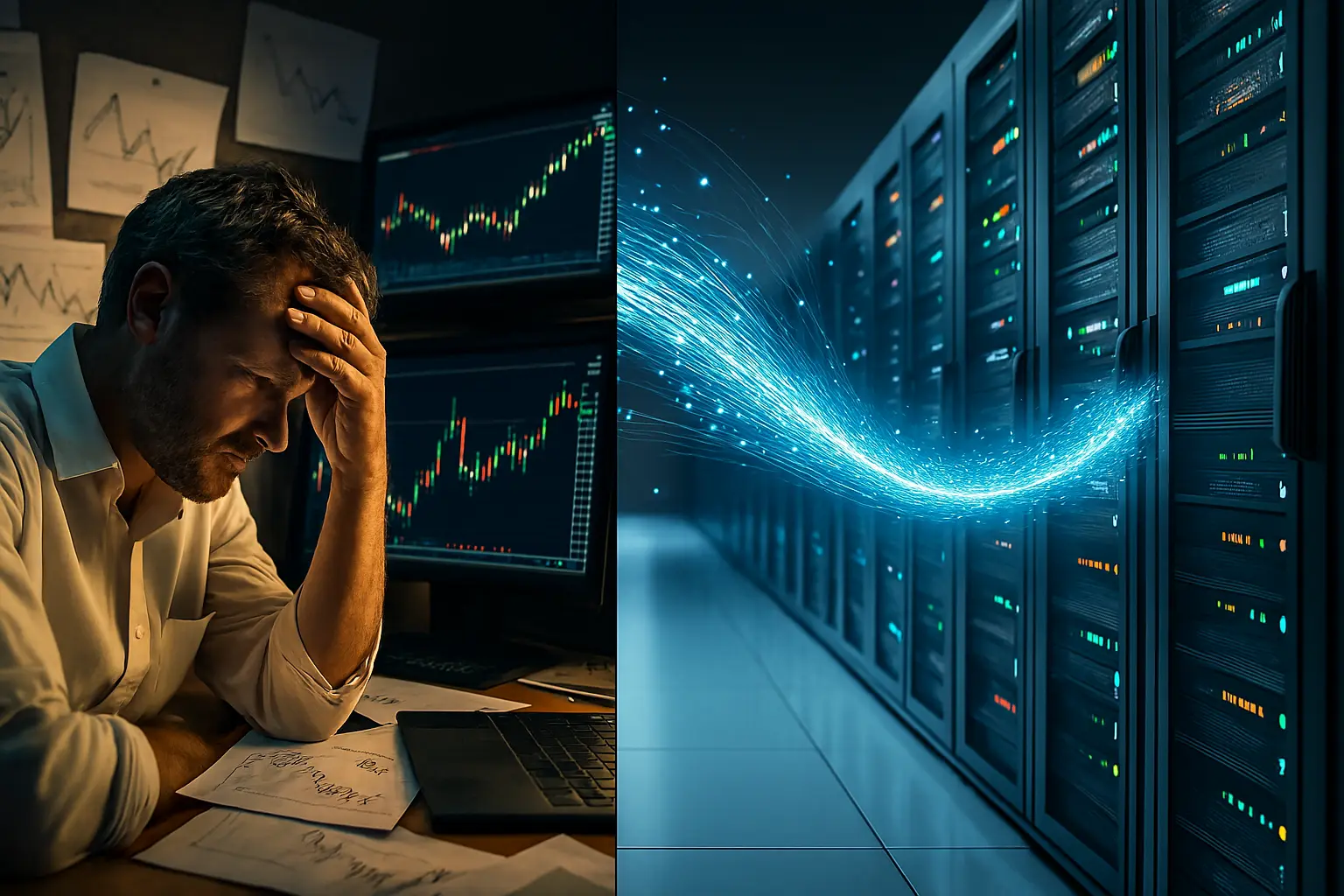
In a high-security building on Wall Street, just a few meters from the exchange, servers belonging to algorithmic trading firms execute thousands of trades per second—without any human intervention. This is the world of algorithmic trading: where computer code replaces emotional human decision-making. But does this signal the end for human traders? Or is a new collaboration between humans and machines taking shape?
In this comprehensive guide, we'll dive deep into the fascinating world of algorithmic trading. From simple strategies to the most complex AI algorithms, from traditional stock markets to the volatile world of cryptocurrencies, we'll cover it all. Whether you're curious about building your own automated system or want to understand how large institutions operate, this article is for you.
Algorithmic trading (also known as algo-trading or automated trading) is the use of computer programs to automatically execute trading strategies based on a set of predefined rules.
To understand this better, let's make a simple comparison. In manual trading, you analyze charts, follow the news, and decide to buy or sell based on your analysis. In algorithmic trading, these processes are handled by a computer program.
But how does the program work? An algorithmic trading system consists of a set of instructions that define specific conditions. For example:
If the price crosses above the 50-day moving average and the RSI is below 70, buy 100 shares.
If the price rises 5% or drops 2%, sell all shares (take profit / stop loss).
A complete algorithmic trading system consists of several key components that work together:
The brain of the system—the set of rules that defines when to buy or sell. The strategy can be based on technical analysis, fundamental analysis, or a combination of both.
The software that executes the strategy. This can be a proprietary application or an existing platform like MetaTrader, TradingView, or a broker's custom platform.
The ability to send orders to your broker or exchange. This includes APIs and communication protocols that connect the system to the market.
Safety systems to prevent catastrophic losses. This includes position sizing, automated stop-losses, and monitoring mechanisms.
These systems operate on a set of simple, predefined rules. For example: "Buy if the price exceeds the 20-day moving average." These are suitable for beginners and can be easily implemented in platforms like TradingView.
These use more complex statistical models, including regression analysis, statistical correlations, and other quantitative techniques. They are typically used by professional traders and institutions.
The most advanced type of algorithmic trading system, using AI and machine learning algorithms to identify patterns and predict price movements. These systems can adapt to market conditions and improve over time.
To fully understand algorithmic trading, we need to look at its history. This journey began in the 1970s and continues to evolve today:
The first ideas for automated trading emerged in the 1970s. Early systems were very simple and rule-based. One of the first examples was the Designated Order Turnaround (DOT) system at NYSE, introduced in 1976.
The 1990s saw massive growth in algorithmic trading. The expansion of the internet and personal computers made the technology more accessible. In 1998, the SEC passed rules that allowed electronic trading systems to operate.
From 2000 onwards, we've seen incredible advances in processing power. The rise of AI and machine learning has created a revolution in algorithmic trading. Today, retail traders also have access to advanced tools.
Algorithmic trading encompasses a variety of strategies, each designed for specific market conditions:
Basic concept: Buying an asset on market A and simultaneously selling it on market B at a higher price. Arbitrage is one of the oldest and most popular trading strategies. In theory, it should be risk-free, but in practice, execution risk exists.
A token trades at $1000 on Binance and $1010 on Coinbase at the same time. The algorithm buys on Binance and sells on Coinbase, earning $8 profit after fees.
The algorithm monitors three currency pairs: EUR/USD, GBP/USD, and EUR/GBP. If the exchange rates become misaligned, it profits through three simultaneous trades.
Calculation: If EUR/USD = 1.1000, GBP/USD = 1.3000, then EUR/GBP should be 0.8462. If it's trading at 0.8500 in the market, an arbitrage opportunity exists.
Basic concept: Executing thousands of trades per second for very small profits. HFT is the most advanced and controversial form of algorithmic trading. Speed is measured in microseconds or even nanoseconds.
The algorithm works on a 1-second timeframe, monitoring price changes every 500 milliseconds and exploiting 0.01% fluctuations.
HFT algorithms can detect large order patterns and profit from the price movement before the large order is fully executed.
High-frequency trading is not suitable for retail traders. Setup costs are extremely high, and competing with large HFT firms is nearly impossible. This strategy also carries its own risks, including technology and liquidity risks.
Basic concept: Identifying and following market trends. This is based on the principle that "the trend is your friend."
The algorithm compares price to 50-day and 200-day moving averages. When the 50-day crosses above the 200-day, it buys (Golden Cross). When it crosses below, it sells (Death Cross).
Sample Rules:
- Stop loss: 2% below entry
- Take profit: 5% above entry
Trend following works best in trending markets. In range-bound markets, it can lead to consecutive losses. The good news is that you can design strategies based on over 100 technical indicators and backtest them on historical data across different markets and timeframes.
Basic concept: Automatically analyzing news and market sentiment. These algorithms analyze outputs from news agencies, social media, and other sources to decide whether to buy or sell.
An algorithm continuously monitors news feeds and uses Natural Language Processing (NLP) to analyze the tone of news articles. Keywords like "profit", "growth", "increase", "decrease", and "loss" are identified.
An algorithm scans tweets and posts about a specific stock or currency and analyzes user sentiment. If overall sentiment is positive, a buy signal is generated.
Interpreting news can be subjective. Markets may react unexpectedly to news, and access to real-time data can be expensive. There's also the risk of fake news leading to poor decisions.
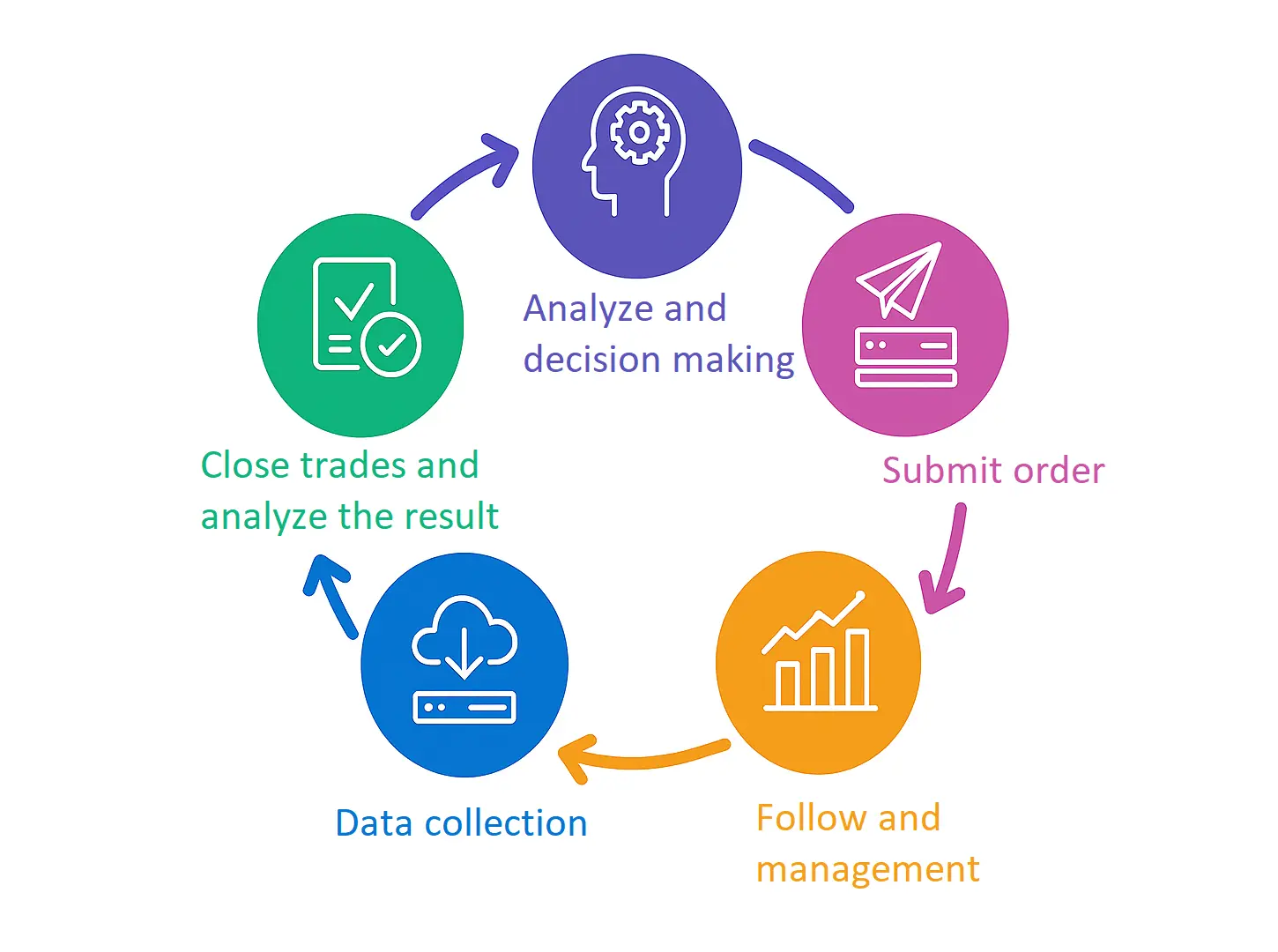
Receiving real-time market data from various sources
Processing data and identifying trading opportunities
Sending trade orders to the market via APIs
Tracking the trade and managing risk
Exiting the trade and analyzing performance
Programming: Python is the best language to start with. Learn Pandas for data analysis, NumPy for numerical computing, and Matplotlib for visualization.
Financial Markets: Understand asset types, market structure, price drivers, and risk/return concepts.
Technical Analysis: Master indicators, chart patterns, and fundamental analysis.
Moving Average Crossover: One of the simplest and most popular methods.
RSI Strategy: Use the Relative Strength Index to identify overbought and oversold areas.
Breakout Strategy: Identify key support/resistance levels and enter on breakouts.
Tip: Start simple and gradually move to more complex methods.
Demo accounts: Most brokers and platforms offer demo accounts for risk-free testing.
Backtesting: Test your strategy on historical data to evaluate its performance.(Learn Python Backtesting step by step)
Forward Testing: Run the strategy on live data with virtual capital.
Caution: Avoid overfitting—ensure your strategy can perform in the future, not just in the past.
Start small: Begin with a small amount of capital that you can afford to lose.
Monitor performance: Track your strategy closely and adjust as needed.
Update strategies: Markets are always changing, so regularly review and update your approach.
Risk management: Implement proper risk management including position sizing and stop-loss orders.
Good News: If you don't have programming skills, Algotradium provides a user-friendly interface where you can build your strategies visually and backtest them on historical data across various markets and timeframes. You can also test your strategies manually in the Algotradium demo environment.
If you'd like to learn how professional traders build and test trading strategies with Python before using the visual builder, read our Simple Python Backtesting Tutorial . You'll learn how to create a complete trading strategy, test it on historical data, and analyze the results using Python.
The oldest and largest market for algorithmic trading. Advantages include high liquidity, transparency, and established regulatory frameworks.
The largest financial market in terms of trading volume. It operates 24 hours a day, 5 days a week, with very high liquidity and variable volatility.
A relatively new market operating 24/7 with high volatility. Regulatory uncertainty is a key characteristic.
Using cutting-edge AI techniques like deep learning and NLP to build more adaptive and complex strategies.
Expansion into emerging markets like NFTs, tokenized assets, and developing economies.
Combining automated trading with decentralized finance, enabling permissionless financial services.
Using non-traditional data like satellite imagery and social media to build more accurate predictive models.
Yes. Algorithmic trading is legal in most countries as long as traders comply with the regulations of their broker and the financial markets they trade.
Absolutely. Many traders begin with simple rule-based strategies before moving to more advanced systems. Learning the fundamentals and testing strategies with backtesting software is the recommended path.
Not necessarily. Modern platforms such as Algotradium allow users to build and backtest trading strategies visually without writing code, although learning Python provides greater flexibility.
The biggest risks include poor strategy design, overfitting during backtesting, unexpected market conditions, and inadequate risk management.
Algorithmic trading can be applied to stocks, forex, futures, and cryptocurrencies. The best choice depends on liquidity, trading costs, and your trading objectives.
Algorithmic trading is no longer a luxury—it's a necessity for professional traders in today's world. As we've seen, it offers numerous advantages: eliminating human emotion, high-speed execution, multi-market monitoring, and precise strategy implementation. However, it also comes with challenges including technical risks, upfront costs, and the need for specialized skills.
Key Takeaway: Success in algorithmic trading requires a combination of financial knowledge, technical skill, and mental discipline. This isn't a get-rich-quick scheme—it's the most scientific approach to trading. In this field, your strategy's rules and parameters are your boundaries, and finding creative solutions within them is the path to success.
Start today—build a simple algorithmic strategy on the Algotradium platform. Start with a basic method like moving averages, test it, and analyze its performance. This is your first step into the exciting world of automated trading.
Remember: a journey of a thousand miles begins with a single step. Start, learn, improve, and be patient. Success in algorithmic trading doesn't happen overnight—it's the result of consistent effort, continuous learning, and adaptability to ever-changing market conditions.
Now that you understand how algorithmic trading works, the next logical step is learning how professional traders test their ideas before risking real capital.
Read our Simple Python Backtesting Tutorial to learn how to build your first strategy, download historical market data, run professional backtests, and analyze trading performance using Python.